

Cart
0

Table of Contents
- Why Fast Fashion Fails the Creative Wardrobe
- The Slow Fashion Benefits That Actually Matter
- How to Build a Capsule Wardrobe Without Losing Your Style
- Sustainable Fashion Brands for Women Who Want Stories, Not Trends
- Creative Alternatives to Buying New: Upcycling, Swapping, Tailoring
- Digital Tools for Managing a Creative Wardrobe
- How to Start Today
- Frequently Asked Questions
Last Updated: September 28, 2026
Why Fast Fashion Fails the Creative Wardrobe
Fast fashion is the mass production of trend-driven clothing at low cost, designed to be worn briefly and replaced quickly. For creative women, that model fails on every level that matters: it erases individuality, floods the wardrobe with pieces that all look the same, and sends tonnes of textile waste to landfill each year.
- Trend uniformity replaces personal expression
- Low-quality construction means garments rarely last past a season
- Opaque supply chains hide labour and environmental costs
- Synthetic fabrics dominate, pushing out natural fibers and handcraft
The Slow Fashion Benefits That Actually Matter
Slow fashion is a design, production and buying approach that prioritises garment longevity, ethical labour and timeless design over speed and volume. Its benefits are practical, not just philosophical.
Cost-Per-Wear: The Only Maths That Counts
Cost-per-wear is the price of a garment divided by the number of times you wear it. A cheap top worn twice costs more per wear than a well-made linen shirt worn for years. That single calculation reframes every purchase decision. Instead of asking "how much is this?", ask "how long will I wear it?"
How to Build a Capsule Wardrobe Without Losing Your Style
A capsule wardrobe is a small, curated set of versatile garments that mix and match across seasons. For creative women, the goal isn't minimalism, it's a foundation you can style expressively. Most capsule advice online assumes you want a uniform of beige knitwear. That advice fails anyone whose wardrobe is built on colour, texture, print and one-off pieces.
The Scaffold Method for Non-Minimalists
Instead of counting down to a fixed number, sort your wardrobe into three tiers and set a rough ratio that suits how you actually dress:
- Scaffold (roughly half your wardrobe): plain, well-fitting basics in fabrics you love, linen shirts, silk camisoles, tailored trousers, a good coat. These are the pieces you reach for without thinking.
- Signature (roughly a third): the pieces that carry your aesthetic, a printed silk scarf, a hand-illustrated top, a vintage jacket with unusual buttons, a bold colour you return to again and again.
- Wildcard (the remainder): the experimental, one-of-a-kind or occasion pieces. These are allowed to be impractical. They are where your creative identity lives.
Choosing a Base That Lets Statement Pieces Sing
A scaffold piece earns its place by being neutral in the right way, not neutral in colour, but neutral in competition. It should not fight your signature pieces for attention.
- Favour natural fibres like linen, silk, wool and cotton over synthetics; they drape better, age better and photograph better for outfit planning.
- Pick timeless cuts over trend-led silhouettes, so the base survives several seasons of your changing taste.
- Choose one or two anchor colours you genuinely wear, then let your signature tier carry the rest of the palette.
- Leave deliberate gaps. A wardrobe with room to add is easier to style than one that is already full.
The Wardrobe Audit: Start With What You Own
A wardrobe audit is a structured review of everything you own, sorting each piece by how often you wear it and why. Most women find they wear a small fraction of their wardrobe regularly, a common pattern is that a minority of pieces do most of the work.
- Pull everything out and lay it flat, grouped by category
- Sort into four piles: keep, repair, restyle, release
- Note gaps and repeated colours or silhouettes
- Photograph the keep pile for reference
- Log cost-per-wear for your most-worn pieces
- Tag each keep piece as scaffold, signature or wildcard
Pro Tip
Photograph your keep pile and store the images on your phone, tagged by tier. When you shop, you'll instantly see whether a new piece works with what you already own, which stops impulse buys, and you'll spot whether you're over-buying scaffold pieces and under-buying signature ones.
When to Break Your Own Rules
A capsule is a tool, not a religion. If a piece sparks genuine joy and gets worn, it belongs, even if it doesn't fit the ratio. The failure mode isn't owning too many clothes; it's owning clothes that never leave the hanger. Track what you actually wear for a month, and let that data, not an arbitrary number, set your limits.
Sustainable Fashion Brands for Women Who Want Stories, Not Trends
Sustainable fashion brands for women are labels that build ethical production, natural materials and supply chain transparency into how they make clothes. The best ones can tell you exactly where a fabric came from and who made the garment, and they can usually tell you why the piece exists beyond a trend cycle.
What 'Sustainable' Actually Has to Prove
Greenwashing is marketing that makes a brand look more sustainable than its practices support. Vague words like "eco", "green", "conscious" or "planet-friendly" mean little without proof behind them. The gap between a genuine claim and a marketing claim usually comes down to specificity.
Real signals to look for:
- Named certifications, not vague badges. A certification has a standard, an auditor and a public register behind it.
- Specific fibre percentages on the care label, "70% linen, 30% silk" tells you something; "natural blend" tells you nothing.
- A published supply chain or maker list naming factories, mills or ateliers.
- Repair or take-back programs that keep garments in use rather than in landfill.
- Batch sizes and restock patterns, small, irregular runs suggest genuine small-batch production; constant new drops suggest a trend cycle wearing a green hat.
A Greenwashing Checklist for Creative Consumers
Creative women are often targeted by "sustainable" marketing because the aesthetic sells. Use this checklist before you buy:
- Find the claim. What exactly is being said, is it about the fibre, the factory, the dye, the packaging, or the whole garment?
- Find the proof. Is there a named certification, a supplier list, or a specific figure? If not, treat the claim as unproven.
- Check the scope. A recycled label on one T-shirt does not make a brand sustainable. Look at whether the claim applies to the whole range or a single product.
- Check the language. Words like "conscious", "responsible" and "eco-friendly" are not regulated terms on their own. Specific, measurable claims are.
- Check the business model. A brand that releases new collections weekly is still a fast-fashion model, regardless of the fabric it uses.
Watch Out
A brand that says "sustainable" without naming a certification, fibre or factory is a red flag. Vague claims are exactly what regulators now scrutinise, and they usually hide a standard fast-fashion supply chain. If you can't find the proof in two minutes, assume it isn't there.
The Creative Angle: Buy for the Story You Can Extend
The most sustainable garment is the one you already own, but the second most sustainable is the one you can keep transforming. When you assess a brand, ask whether its pieces give you room to work: can the hem be taken up, the seams let out, the fabric dyed or embroidered, the buttons swapped? A well-made garment in a natural fibre can be restyled for years.
Creative Alternatives to Buying New: Upcycling, Swapping, Tailoring
Upcycling is the practice of transforming an existing garment into something new and higher value, rather than discarding it. It's the most creative route open to you, and often the most personal.
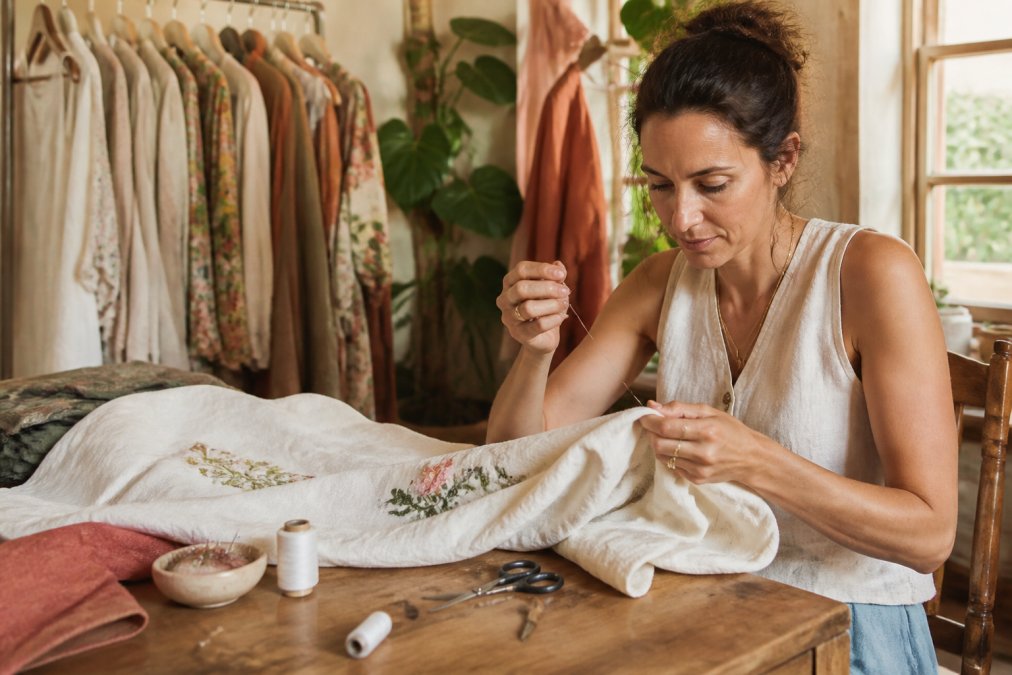
Beyond upcycling, three more options keep clothes in circulation:
- Clothing swaps with friends or local groups refresh your wardrobe for free
- Tailoring reshapes vintage or second-hand finds to fit you perfectly
- Repair and mending extend garment longevity by years
Digital Tools for Managing a Creative Wardrobe
Digital wardrobe apps let you catalogue, plan and track the cost-per-wear of every garment you own. They turn a chaotic closet into a searchable, styled archive.
- Catalogue every piece with a photo
- Tag by season, colour and occasion
- Plan outfits before you buy anything new
- Track cost-per-wear to guide future purchases
How to Start Today
| Step | Action | Time | Frequency |
|---|---|---|---|
| 1 | Wardrobe audit | 2 hours | Twice a year |
| 2 | Log cost-per-wear | 30 minutes | Monthly |
| 3 | Repair or tailor | 1 hour | As needed |
| 4 | Swap or thrift | 2 hours | Quarterly |
| 5 | Buy one quality piece | Varies | When a real gap appears |
Frequently Asked Questions
What are some stylish alternatives to fast fashion for creative women?
The most stylish alternatives combine second-hand shopping, upcycling, clothing swaps, and investing in small-batch pieces from independent labels that use natural fabrics. A creative wardrobe built on timeless design and quality over quantity gives you more room for self-expression than trend-driven buys. Look for hand-illustrated prints, heritage-inspired textiles, and pieces that tell a story you actually want to wear. Tailoring existing garments is another option that turns ordinary items into one-off pieces.
How do I build a capsule wardrobe that still feels creative?
Start with a wardrobe audit: pull everything out, sort by how often you wear it, and note the gaps. Choose 25 to 35 core pieces in a colour palette you love, then add one or two statement items that carry your personality, such as a hand-illustrated silk scarf or a linen blazer with unique detailing. The point of a capsule wardrobe is not minimalism for its own sake. It is a framework that frees you to choose pieces with real character.
How can I tell if a sustainable fashion brand is genuinely ethical?
Look for supply chain transparency: named factories, published material sourcing, and details on how garments are made. Certifications such as Fairtrade or GOTS for organic textiles help, but small brands often rely on direct communication instead. Check whether the brand explains its production scale (small-batch versus mass), names its fabrics (linen, silk, organic cotton), and can answer questions about labour conditions. Vague claims like 'eco-friendly' without specifics are a warning sign of greenwashing.
Why is choosing natural fabrics like linen and silk better for the planet?
Natural fibres such as linen and silk biodegrade at end of life, unlike most synthetic alternatives that shed microplastics and persist in landfill for decades. Linen, made from flax, needs less water than conventional cotton and can be grown with fewer chemical inputs. Silk is long-lasting and repairable, which supports garment longevity. Both fabrics also feel better against the skin and age well, making them a practical choice for a wardrobe you intend to keep for years rather than seasons.
Fast fashion rewards speed; a creative wardrobe rewards intention. If you want pieces that carry a story, look for labels that use natural fabrics, small-batch production and hand-illustrated design. a.nty story builds exactly that: original artwork turned into wearable pieces, made in limited runs from linen and silk. Explore the collection and wear your story.